| How would you invest One Billion Dollars to create shared prosperity, long-lasting positive social change, and a pathway to a more equitable economy? The wealth gap is wider than ever before. Nearly 3,000 people in the United States are billionaires, representing 9% year over year growth from 2024 to 2025 (Entrepreneur). The K-Shaped economy is fueling growth for the very wealthy while also creating a larger inequality gap on a daily basis (US Bank). We’re here to powerfully mobilize assets in care for our current economy while simultaneously building an equitable economy that will serve us all. We have an opportunity to change financial and investment strategies – at scale – for the communities that our team represents and is connected to. We love to dream big, create bold plans and truly bring them to life. Here’s one way we would approach this question: The 50/50 Portfolio 50% allocated to socially responsible public equities and 50% allocated to impact investments across private credit, private equity, venture capital, municipal bonds, and real estate for a 7% expected return over a 30-year horizon with rebalancing efforts that increase impact over time. Magnify impact at every level and over time. Read on to learn more. *Disclaimer – this is not investment advice. This is a hypothetical scenario, but could be scaled up or down and made real today for certain foundations, endowments, and other pools of capital that are held by mission-driven institutions and families. Contact the Investment Team to Learn More |
| Our Approach to Impact : The 50/50 Portfolio for Impact Investing Investment Objective: To align capital with a transition towards a more just society by reducing inequalities, investing in decent work and economic development, and bolstering strong institutions in underinvested communities through capital allocation. Impact Investment Focus Areas: 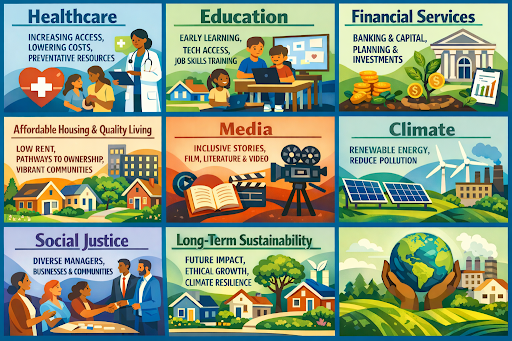 Investment Horizon: 30 years. We imagine two generations can set a new era of possibilities. 30 years have proven to be time for substantial change through recent history. From 1950-1980 things changed from pre civil rights to post civil rights,From 1990-2020 we went from pre-internet to internet on multiple devices per person, From 2020-2050 we will see another massive change, as this time period will be driven by investment in a world of artificial intelligence Risk Tolerance: We see an opportunity to take substantial risk because of the size of the portfolio and intended objectives to create meaningful impact. This means our portfolio will be focused on creative, catalytic equity investments that grow strong institutions and solve for inequities. The model can be adjusted to either increase or decrease risk after the initial 50/50 allocation: Increased risk (Max impact): Reinvesting all public equity returns into impact investments increasing impact investments over time. Baseline risk (50/50 impact): Allocate all public equity and impact returns to maintain 50/50 allocation. Decreased risk (Spend Down impact): Allocating all public equity and impact returns to giving, driving larger charitable contributions. Portfolio Allocation: 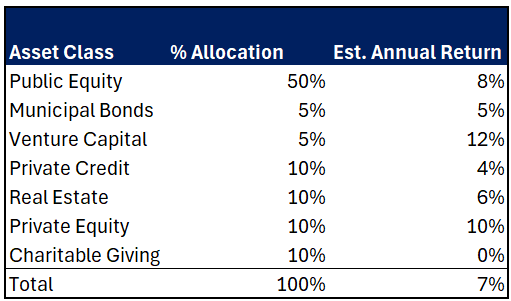 We want the 50/50 portfolio allocation to do two things: Contribute capital to impact investment focus areas to drive transitional change. Be self sufficient over time.If all goes correctly, the portfolio should contribute more than originally anticipated to impact, as the appreciation from investments will serve as reinvestment capital and / or regenerative pool of funds for giving and investing, rather than accumulating excess wealth. Public Equities: 50% Investing in the public markets creates sustainable, liquid income while meeting the ongoing need to offset inflation. The 50% allocation creates the chance to invest in socially responsible companies, while also achieving the appreciation and liquidity necessary to cover long term cash needs. There’s an opportunity to use a portion of this allocation to hold individual positions in companies that we wish to help improve by joining shareholder campaigns, allying with workers, and engaging in the democratic process of proxy voting. These actions, in effect, can help shift global companies towards honoring their long term responsibility to their shareholders and stakeholders. Municipal Bonds: 5% Funding public projects like schools, hospitals, highways, and water systems are in-line with our investment objectives. Municipal bonds give investors the opportunity to take part in local or state projects in areas of their choice, while receiving a tax benefit on the interest income received. The flexibility of the maturity schedule, whether it be less than 5 years or more than 10, can help us create the cash flow injections for reinvestment or giving down the line. Venture Capital: 5% This type of venture is different from your average. It provides well-needed capital to the entrepreneurs and founders that may not have the resources personally or within their networks to fund their business idea. The business may not expect or desire to become the next unicorn, but rather one that has a sound strategy, solves a problem and is able to grow profitable within the next 3 – 7 years. Options to realize the investment while achieving equity goals can work in multiple ways: The ownership stake can be sold back to the owner or employeesThe business generates earnings and makes distributions to equity ownersThe business may have an Initial Public Offering The business may be prepared for acquisitionThe equity remains patient, not seeking a liquidity event for the foreseeable future. Private Credit: 10% Debt is typically the lowest cost of capital to investments looking to grow but it comes with the requirement of meeting Debt Service Coverage Ratios of sometimes as high as 1.5x Operating Profit. The burden of debt can hamper some businesses so that’s where some creativity comes in. Debt payments can be repaid in a number of ways:Interest-only period Full standby – with no payments for a periodRevenue based financing – matching the growth of the companyFull principal & interest repayment starting within Year 1 As we think about maximizing impact we want to do two things in the private credit market:Keep rates relatively lowAvoid becoming an immediate burden to the companyThis allows for cash to be invested fully by the business without the immediate need for debt repayment. Community Development Financial Institutions (CDFIs) and Impact First Loan Funds are two providers of capital. Real Estate: 10% The need for affordable housing is large and growing, as wage increases have not kept up with the increase in rental and home ownership prices. Investing in real estate can work alongside local governments and communities to build or replace the housing infrastructure that is desperately needed across most metro areas. Projects may include commercial real estate for businesses, health, or education services in local communities. Providing equity stakes as early investors can jumpstart projects that are in need of capital to solve a major problem, as well as yield both appreciation and income to return to the portfolio. Private Equity: 10% Private Equity Investors have flourished in many ways and with so much capital in the world’s private markets we think that trend will continue. Within private markets there’s also the possibility for a much higher level of alignment with investment objectives – the ability to explicitly invest in companies that have not been entrenched in corporate structures but possess domain expertise. We seek companies with high wages and incentive bonus structures such as cash bonuses and equity compensation – especially for employees that traditionally have been left behind in wage growth even though they have contributed significantly to the company’s bottom line. Let’s encourage more companies to invest in their people first and reduce the world’s growing wealth gap. Research shows employee owned companies tend to outperform over the long run. Also, strong governance enables a broader pool of stakeholders to be aware of key company decisions. Co-Ops, ESOPs, and EOTs have a long history of implementing such practices. Charitable Giving: 10% We’ll make sure that $100M is set aside for giving immediately. Whether you create a giving plan that’s driven by direct giving or partnerships with re-granting organizations, we know that we have to immediately move capital to organizations and networks that are doing great work; the time is now. This commitment additionally creates opportunities to catalyze private impact investments by giving additional infrastructure or technical assistance grants, offsetting tax impacts of transitioning the portfolio to private markets (depending where it was invested previously), and moving towards matching the percent of income and net wealth given annually to charitable efforts by our low-income peers (Fortune). While starting with 10% may still pose a challenge in giving quickly and efficiently, it is a manageable goal. Expected Return: 7% An expected 7% annual return with the potential for high impact is a great balance of prudence and stewardship. Every year, we’d rebalance the portfolio to reinvest capital in impact investments and/or to increase our ability to give. This return creates the balance needed for liquidity, impact, and giving over an extended period of time. Ongoing Monitoring Rebalancing: Based on the preference of risk, we’d reallocate capital annually, where possible. This gives us a fresh opportunity to fund new ideas, support growing organizations, and to “spread the wealth” as best we can. What questions do you have? Are you wondering… “What’s the implementation roadmap?” “What are appropriate benchmarks?” “How would this portfolio ensure liquidity needs for a foundation or DAF account host?” “What if I want to include specific place-based investments?” We love to hear your questions and we have answers! Follow us on LinkedIn and schedule a chat with our Investment Team. Share Your Questions and Curiosities |
Two Great Wealth Transfers, One Moment
NSIA Invests in Community and Helps Community Invest Right now, two massive transfers of wealth are underway in the US at the same time —