Why Reach Matters When Building A Bridge Across the Wealth Spectrum
A 5-minute read
My work asks me to think about both ends of the wealth spectrum: the person ready to invest their first $100, and the institution deciding where to deploy billions.
Most of my industry would tell me to pick one. Choose a lane. Set an account minimum and stay above it.
I’ve chosen the bridge instead. Here’s why I believe reach, not just returns, is what will close the gap between those who have wealth and those who are building it.
The Wealth Spectrum Is a Continuum
The financial industry tends to sort people and their wealth into boxes. Working Class. Mass affluent. High net worth. Institutional. Each box gets its own products, its own advisors, and its own front door.
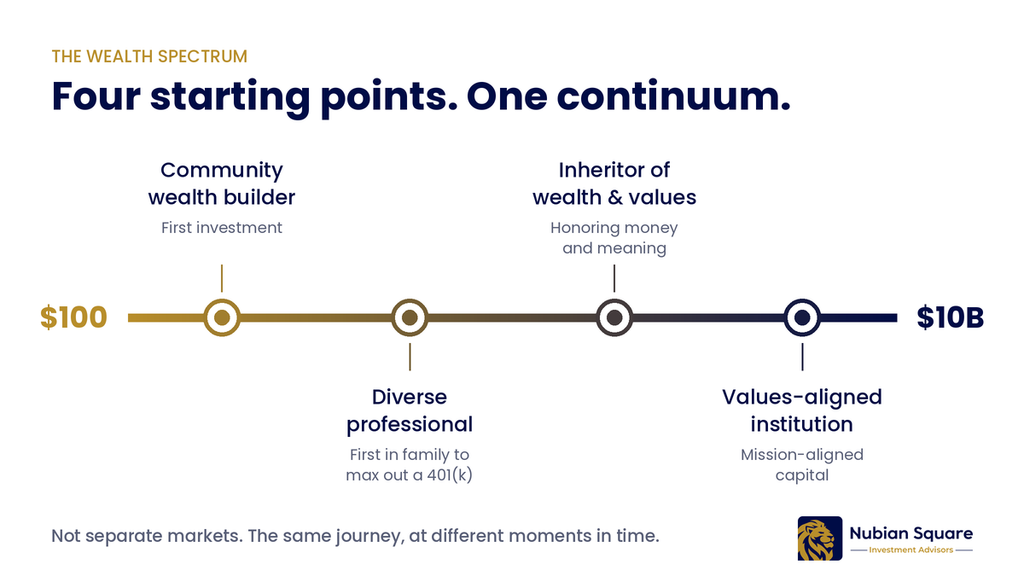
But wealth doesn’t have to live in boxes. It can move along a continuum but often needs help to do so.
The first-gen wealth builder landing the job and opening a first investment account. The professional who just became the first in their family to max out a 401(k). The inheritor wondering how to honor both the money and the values behind it. The foundation board asking whether its endowment reflects its mission.
These aren’t separate markets. They are points along the wealth spectrum. When we draw hard lines between them, we build walls at the exact moments advisors need to provide transparency: the first paycheck saved, the first business launched, the first inheritance received, the first community investment made.
Why Reach Matters
Reach is usually treated as a marketing metric. How many people saw the post? How many leads came in?
I think of reach differently. Reach decides who gets access to sound advice, to impact opportunities, and to long-term planning. It decides whose questions get answered and whose get ignored.
A firm that serves only the top of the spectrum can’t fully understand the communities its capital claims to help. It sees neighborhoods as portfolios, not as places where people live.
A firm that serves only the bottom of the spectrum can’t move the institutional dollars that change systems. It can help families one at a time, but it can’t redirect the river.
Reach across the full spectrum gives you both: proximity and scale. You need both to build anything that lasts.
The Bridge Runs Both Ways
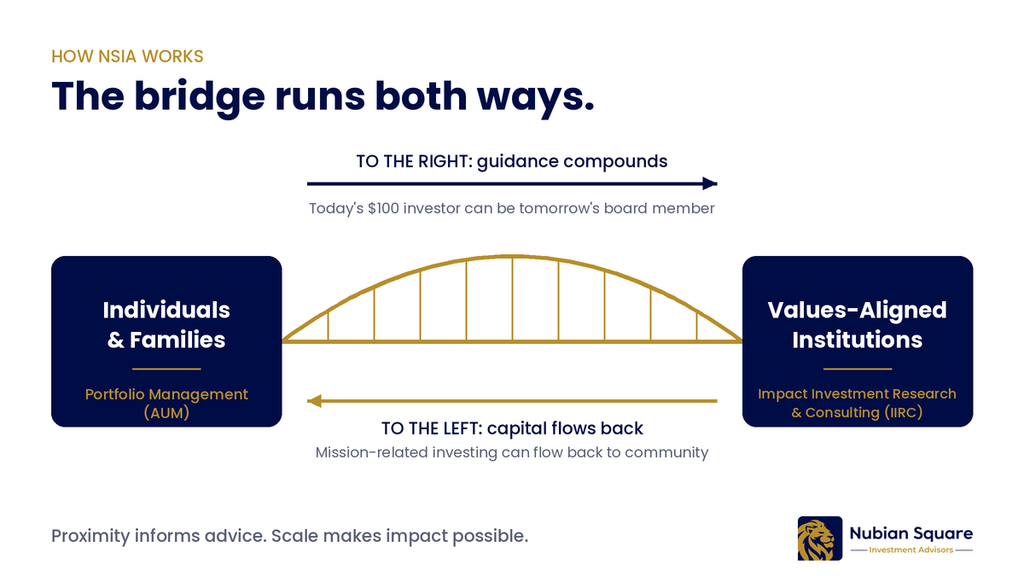
A bridge isn’t a ladder. Traffic moves in both directions.
To the Right, the person investing $100 today can become the small business owner, the family steward, or influence the board member directing institutional capital. Early guidance can build on itself over time, much like early savings can. The habits, confidence, and trust built at $100 shape every decision that follows.
To the Left, institutional capital deployed through mission-related investing can flow back into the neighborhoods where first-time investors live. Community development financial institutions, affordable housing, small business lending, and local enterprise all depend on capital that someone, somewhere, chose to direct with intention.
Each end strengthens the other. Proximity to community makes institutional advice better informed. Institutional scale makes community impact possible. When one advisor holds both ends, the insight travels across the bridge too.
What This Looks Like in Practice
At Nubian Square Investment Advisors, we built our firm around this idea. We work in two practice areas that sit at opposite ends of the bridge.
- Portfolio Management (AUM) serves individuals and families: community wealth builders, diverse professionals, and inheritors of wealth and values who want their money to reflect who they are.
- Impact Investment Research & Consulting (IIRC) serves values-aligned institutions that want to deploy community capital and mission-related investments with rigor.
The lessons move between them. What we hear from a client building wealth for the first time informs how we advise an institution on community investing. What we learn from institutional due diligence sharpens the opportunities we can bring to individual clients.
The two scenarios below are illustrative. They reflect situations common across the wealth spectrum and do not describe any specific client.
Picture a mother building against the odds. She navigates daily life in more than one language. She may be the first in her family to think about investing at all. The financial system wasn’t built with her in mind, and much of it still speaks only one language.
But she has a vision. She wants her children to start life with a foundation she never had, and she wants a future for herself that doesn’t depend on working forever. Her first contribution may be modest. Her intention is not. What she deserves is an advisor who takes her goals as seriously as any seven-figure client’s, and who explains every step until it makes sense to her.
Now consider an institution overseeing billions. Its leadership wants to connect its capital to communities in a real way, not just in its annual report. But it runs into questions it never had to consider before. How do you evaluate a community development lender? How do you measure impact without imposing it? Who from the community should be at the table?
Answering those questions takes specialty expertise its internal team may not have. Rather than build that capacity from scratch, an institution like this can bring in outside research and consulting partners while still managing its own assets and making its own decisions. That isn’t a step back from its mission. It’s a way to double down on it.
Two very different starting points. The same destination: capital working on behalf of the people and places it’s meant to serve.
No single firm can build this bridge alone. It takes governmental and non-governmental economic development organizations, community-based institutions, investing collectives and donor networks, and peers who share the vision. The bridge is an ecosystem.
A Challenge to Our Industry
Account minimums are a business decision, not a law of nature. They can be rethought.
Impact investing loses credibility when it is designed about communities rather than with them. If the people a strategy aims to serve are never in the room, the strategy is incomplete.
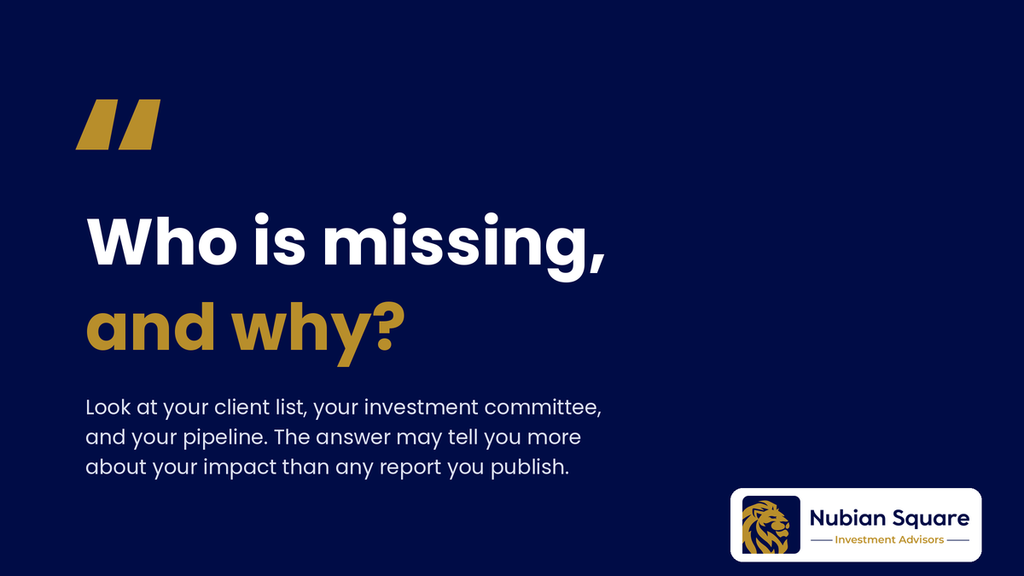
So here is my challenge to fellow advisors, foundations, endowments, and family offices. Look at your client list, your investment committee, and your pipeline, and ask one simple question:
Who is missing, and why?
The answer may tell you more about your impact than any report you publish.
From $100 to $10 Billion, the Mission Is the Same
Whether the starting point is $100 or $10 billion, the work comes down to the same thing: aligning capital with values, and helping build lasting wealth in the places it has too often been withheld.
The gap between the two ends of the wealth spectrum is real. But gaps can be crossed. That’s what bridges are for.
We’d love to hear from you: Where are you on the wealth spectrum today, and who helped you cross the last gap? Share in the comments.